Advanced Sorting

Heap Sort — O(N log N)
No additional array required.
Algorithm Steps
- Make the array you want to sort on Heap (Heapify) — O(N)
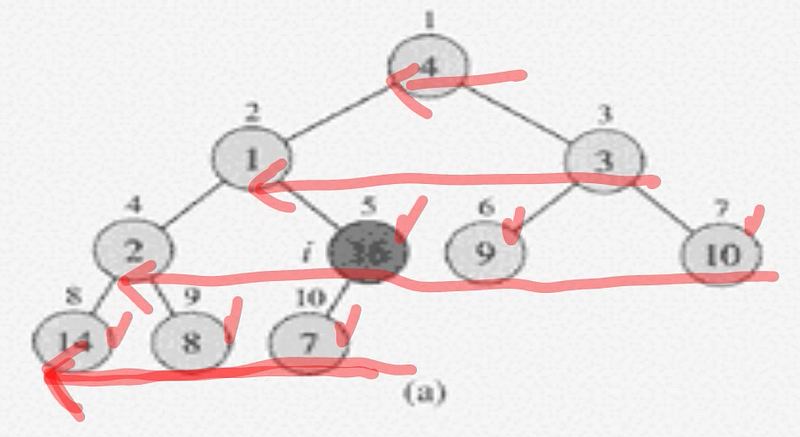
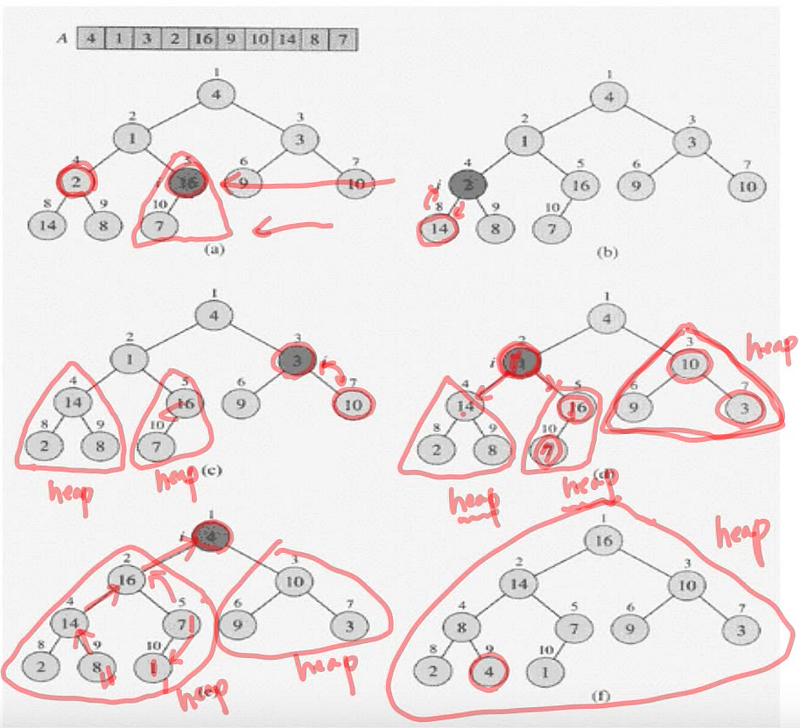
func buildMaxHeap(_ n: Int) {
    for i in (1...(n / 2)).reversed() {
        maxHeapify(i, n)
    }
}- In the heap, change the maximum value (root node) to the last value.
- The size of the heap is assumed to be reduced by one. That is, the last value is not considered part of the heap.
- Heapify for the root node.
- Repeat steps 2 to 4.
func heapSort(_ n: Int) {
    buildMaxHeap(n)
    for i in (1...n).reversed() {
        let temp = data[1]
        data[1] = data[i]
        data[i] = temp
        maxHeapify(1, i - 1)
    }
}
Radix Sort — O(d × (n + k))
Default assumption: number of values are n and d-digit integers.
We sort from the last digit. Each digit is sorted by a stable sorting (counting sort, bucket sort) algorithm.

func radixSort(_ array: inout [Int]) {
    let radix = 10  // Here we define our radix to be 10
    var done = false
    var index: Int
    var digit = 1  // Which digit are we on?

    while !done {  // While our sorting is not completed
        done = true  // Assume it is done for now
        var buckets: [[Int]] = []

        // Our sorting subroutine is bucket sort,
        // so let us predefine our buckets
        for _ in 1...radix {
            buckets.append([])
        }

        for number in array {
            index = number / digit  // Which bucket will we access?
            buckets[index % radix].append(number)
            if done && index > 0 {
                // If we aren't done, continue to finish,
                // otherwise we are done
                done = false
            }
        }

        var i = 0
        for j in 0..<radix {
            let bucket = buckets[j]
            for number in bucket {
                array[i] = number
                i += 1
            }
        }

        digit *= radix  // Move to the next digit
    }
}